
Logo detection sponsorship tracking is solving one of the biggest problems in sponsorship marketing today: brands spending millions on exposure with no real way to prove what they got in return. Sponsorship deals are worth more than $75 billion globally every year, yet a shocking number of brands still can’t answer a simple question: “What did we actually get for our money?” That gap between spending and proof is exactly why logo detection sponsorship tracking has become the most talked-about innovation in sports marketing, media analytics, and brand partnerships.
If you’re a brand manager, a rights holder, a marketing agency, or a broadcaster, this article breaks down everything you need to know about how AI-driven logo detection works, why it matters more than ever in 2026, and how a platform like AIM Vision from AIM Technologies is redefining what sponsorship measurement looks like.
Why Sponsorship Tracking Has Become a Business-Critical Function
For decades, sponsorship valuation relied on rough estimates, manual counting, and guesswork. A team of analysts would sit and literally count how many seconds a logo appeared on screen during a match or event. This approach was:
- Slow and labor-intensive
- Prone to human error
- Impossible to scale across multiple events or channels
- Lacking any real-time insight
Fast forward to today, and brands are spending massive budgets on stadium boards, jersey logos, digital overlays, and event signage. Without accurate, automated tracking, that spend is essentially a black box. Marketing leaders are under constant pressure to justify budgets, and “brand visibility” is no longer a soft metric — it needs hard numbers attached to it.
This is where logo detection sponsorship tracking steps in, turning subjective impressions into measurable, auditable data.
What Is Logo Detection Technology?
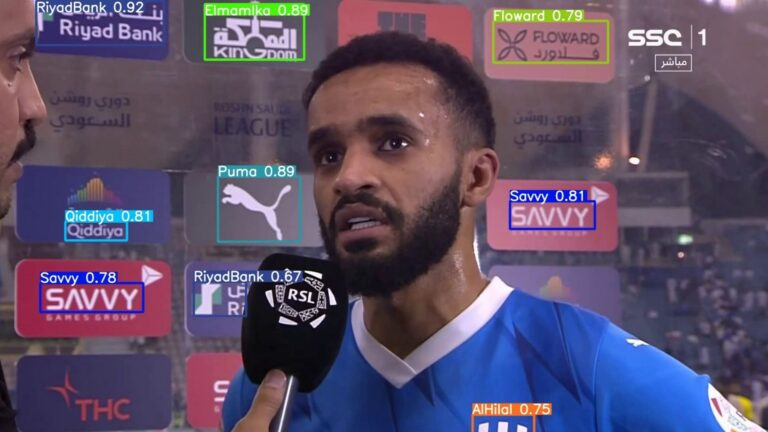
Logo detection is a computer vision application that uses artificial intelligence and deep learning models to automatically identify brand logos within video footage, images, or live broadcasts. Instead of a human watching hours of footage, an AI model scans every frame, recognizes logos, and generates detailed exposure reports in a fraction of the time.
Here’s what modern logo detection systems can typically identify and measure:
- Logo appearance frequency (how many times a logo appears)
- Total exposure duration (how many seconds/minutes it’s visible)
- Logo size and screen placement (center screen vs. corner, big vs. small)
- Visibility quality (partial vs. full logo, obstructed vs. clear)
- Broadcast reach (which channels, regions, or platforms aired the content)
- Estimated media value (translating exposure into a monetary equivalent)
This level of detail was simply impossible to achieve manually at scale — and it’s exactly why logo detection sponsorship tracking has become a non-negotiable tool for any serious sports or entertainment brand strategy.
The Real Business Value of Sponsorship Tracking
Let’s talk numbers, because that’s what stakeholders actually care about. Brands and rights holders using automated sponsorship tracking report several tangible benefits:
- Clear ROI justification: Marketing teams can show exact media value generated versus sponsorship cost, which strengthens renewal negotiations.
- Smarter negotiation power: Rights holders can price sponsorship packages based on real historical exposure data instead of estimates.
- Competitive benchmarking: Brands can compare their exposure against competitors sponsoring the same event or league.
- Multi-platform insight: Tracking spans TV broadcasts, streaming platforms, and social media clips, giving a full-funnel view of exposure.
- Faster reporting cycles: What used to take weeks of manual review can now be delivered in near real-time or within hours after an event.
For agencies managing multiple client accounts, this isn’t just a nice-to-have — it’s the difference between winning and losing client trust year after year.
Industries Benefiting Most From Logo Detection Sponsorship Tracking
While sports sponsorship is the most obvious use case, logo detection sponsorship tracking has expanded well beyond stadiums and pitches. Industries actively using this technology include:
- Football, basketball, motorsport, and e-sports sponsorships
- Broadcast and media monitoring companies auditing ad placements
- Esports and gaming tournaments with digital overlays and in-stream branding
- Retail and product placement tracking in TV shows and influencer content
- Event organizers measuring signage and banner visibility at conferences and expos
- Streaming platforms auditing branded content compliance
Basically, anywhere a logo appears and money is tied to that visibility, there’s now a data-driven way to measure it.
How AI-Powered Logo Detection Actually Works
For those curious about the mechanics, here’s a simplified breakdown of the process:
- Video ingestion: Footage from broadcasts, streams, or recorded events is fed into the system.
- Frame-by-frame analysis: The AI model scans each frame using trained neural networks capable of recognizing thousands of logo variations, angles, and lighting conditions.
- Object detection and classification: The system identifies not just that a logo appeared, but which brand, how large, and where on the screen.
- Data aggregation: All detections are compiled into structured reports covering duration, frequency, and estimated value.
- Dashboard delivery: Results are pushed into a visual, easy-to-read dashboard for stakeholders to review and export.
The sophistication of the underlying AI model determines accuracy — and this is exactly where many platforms fall short, especially with logos that appear partially obstructed, in motion, or at unusual angles.
Introducing AIM Vision: Smarter Sponsorship Intelligence
This is where AIM Vision, developed by AIM Technologies, stands out in a crowded market.
AIM Vision is a computer vision platform purpose-built for logo detection sponsorship tracking, designed to give brands, agencies, and rights holders a level of precision and speed that manual or generic tools simply can’t match.
Here’s what makes AIM Vision different:
- High-accuracy detection engine: AIM Vision is trained to recognize logos even under difficult conditions — partial visibility, fast motion, low lighting, or unusual camera angles — reducing false negatives that plague weaker systems.
- Multi-source monitoring: The platform tracks exposure across TV broadcasts, digital streams, and social media content, giving a unified view of brand visibility across every channel that matters.
- Real-time and post-event reporting: Whether you need live monitoring during an event or a full post-match analysis, AIM Vision adapts to both use cases without sacrificing accuracy.
- Media value calculation: AIM Vision doesn’t just tell you a logo appeared — it converts that exposure into estimated advertising equivalent value, giving marketing teams a number they can bring straight into a boardroom presentation.
- Customizable dashboards: Reports are structured to match how different stakeholders think, whether that’s a sponsorship manager looking at duration metrics or a CMO looking at overall campaign ROI.
- Scalability across events and sports: From a single local tournament to a full international league season, AIM Vision is built to scale without losing detection quality.
- Competitor benchmarking tools: Brands can directly compare their logo exposure against competing sponsors within the same broadcast or event.
For sponsorship teams tired of vague reporting and inconsistent data, AIM Vision essentially works as an always-on auditor — one that never blinks, never tires, and never miscounts.
What to Look for When Choosing a Logo Detection Sponsorship Tracking Platform
If you’re evaluating vendors in this space, here are the key questions to ask before signing any contract:
- How accurate is the detection model with partially visible or moving logos?
- Does the platform support live broadcasts, VOD, and social media content?
- Can it calculate estimated media value, not just raw exposure time?
- How fast are reports delivered after an event?
- Is the dashboard easy for non-technical stakeholders to understand?
- Can the system scale if you expand into new sports, regions, or platforms?
- What kind of customer support and onboarding is included?
Any platform that can’t confidently answer these questions probably isn’t ready for serious enterprise use.
The Future of Logo Detection Sponsorship Tracking
Looking ahead, sponsorship tracking is only going to get more sophisticated. A few trends worth watching:
- Deeper integration with social media analytics, since fan engagement increasingly happens on Instagram, TikTok, and YouTube rather than just live broadcasts
- AI models that can measure sentiment around a brand’s exposure, not just visibility
- Predictive analytics that forecast expected exposure value before brands even sign a sponsorship deal
- Greater demand for transparency from sponsors who want proof before renewing multi-year contracts
Brands that adopt these tools early will have a significant advantage in negotiations, budget justification, and long-term partnership strategy. Those that continue relying on manual estimates will increasingly find themselves outpaced by competitors armed with real data.
Final Thoughts
Sponsorship spending is only going up, and so is the pressure to prove it’s worth it. Logo detection sponsorship tracking has moved from “interesting innovation” to “essential business tool” in a remarkably short time. Whether you’re a rights holder trying to price your inventory correctly, a brand trying to defend your marketing budget, or an agency trying to keep clients happy, the ability to measure exposure accurately is no longer optional.
Platforms like AIM Vision are leading this shift by combining advanced computer vision with practical, business-ready reporting that turns raw video data into decisions you can actually act on.
If your team is still relying on manual counts or vague estimates to justify sponsorship spend, now is the time to change that.
Request a demo from AIM Technologies today and see exactly how AIM Vision can transform the way you track, measure, and prove sponsorship value — with real data, not guesswork.